Drug · EGFR TKI · EGFR TKI · Sourced compound
Osimertinib structure · mechanism
PubChem CID 71496458. Molecular formula C28H33N7O2. Independently assigned structure; reviewed 2026-10-08. Family grouping is editorial and does not establish shared activity.
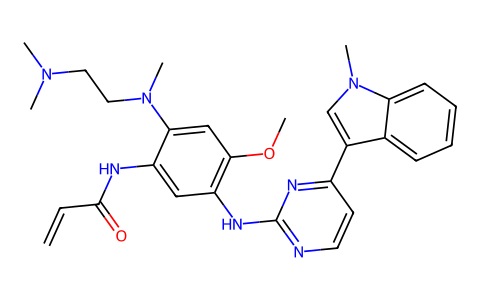
Osimertinib 2D structure
- Role
- Drug
- Mechanism class
- EGFR TKI
- Aliases
- tagrisso
- InChIKey
DUYJMQONPNNFPI-UHFFFAOYSA-N
- Structure checked
- 2026-10-08
- Molecular formula
- C28H33N7O2
- Structure source
- PubChem
- PubChem CID
- 71496458
- InChI Key
- DUYJMQONPNNFPI-UHFFFAOYSA-N
- FDA / EMA
- FDA/EMA
- ClinicalTrials.gov
- osimertinib NSCLC
Read the two structures
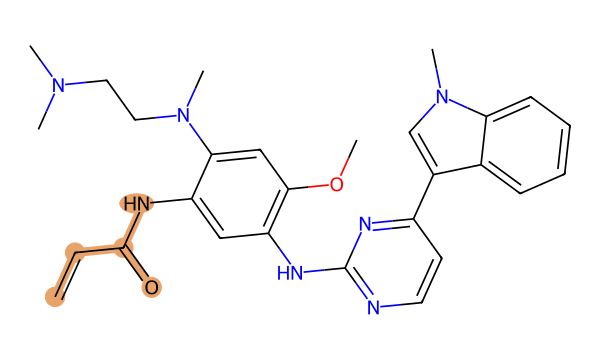
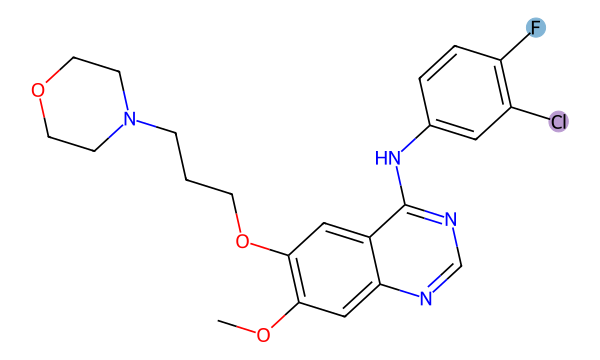
Compare the ring regions, oxygen-containing connections and nitrogen-containing side chains of osimertinib and gefitinib in sequence. Reading regions separately makes shared and different local environments easier to describe without equating target-family membership with a shared complete scaffold.
| Observation | Osimertinib | Gefitinib |
|---|---|---|
| Acrylamide connectivity | 1 | 0 |
| Fluorine atoms | 0 | 1 |
| Chlorine atoms | 0 | 1 |
Connect the structural observations with the fingerprint result
One C=C–C(=O)–N motif is detected in osimertinib and none by the same query in gefitinib. Gefitinib’s one fluorine and one chlorine are marked separately. This provides concrete connectivity and element observations within the EGFR grouping. [Osimertinib] · [Gefitinib]
Nineteen shared set bits across a union of 111 give 0.171. The class groups comparison subjects by target context, while this calculation compares radius-2 atom environments. These are different kinds of similarity.
The unsaturated connection is a structural query result. Reaction-rate and protein-binding measurements are absent, so the coloured motif cannot establish binding mode or activity against a particular mutation.
Calculated structural similarity: 0.171 · Morgan radius 2 / 2048 bits · Tanimoto
Calculation: 19 / (70 + 60 − 19) = 19 / 111 ≈ 0.171. Set-bit counts are not counts of unique atoms or functional groups.
Query definitions and reproducibility
- Acrylamide connectivity:
C=CC(=O)N - Fluorine atoms:
[F] - Chlorine atoms:
[Cl]
RDKit 2025.03.4 · Matches with identical atom sets are counted once. Colours mark atoms and bonds matching selected queries, not a proven shared scaffold or synthesis route.
- Read elemental composition from the formulas.
- Trace ring and substituent connections in each drawing.
- Compare your observations with the fingerprint score calculated under identical settings.
- Check stereochemistry and the complete InChIKey in the source records.
The score is fingerprint overlap, not a percentage of efficacy or safety. RDKit
Structure-source check: 2026-10-08 / 2026-10-08 · Editorial update and calculation check: 2026-10-16
Download source structures, queries and bit counts for this comparison (JSON)
StructureMoa editorial · source review 2026-10-08
Molecular identity
Osimertinib: independently retrieved PubChem CID 71496458, formula C28H33N7O2.
How to compare
Compare the ring regions, oxygen-containing connections and nitrogen-containing side chains of osimertinib and gefitinib in sequence. Reading regions separately makes shared and different local environments easier to describe without equating target-family membership with a shared complete scaffold.
Interpretation limits
The Morgan/Tanimoto score measures fingerprint overlap. It does not establish efficacy, safety, clinical superiority or full stereochemical identity.
SMILES
CN1C=C(C2=CC=CC=C21)C3=NC(=NC=C3)NC4=C(C=C(C(=C4)NC(=O)C=C)N(C)CCN(C)C)OCTags
Related compounds
Comparisons · briefs
External IDs · BioMoa
StructureMoa is a chemical-structure exploration tool. Structural similarity, clustering, and SAR relationships are intended for research exploration and do not establish shared potency, selectivity, safety, efficacy, or clinical performance.
Editorial responsibility and corrections
Operated and edited by the independent StructureMoa project. Explanations use AI assistance; structural identity and similarity are checked against source records and calculation tests. Molecular data and clinical or regulatory evidence have separate review scopes.
- Source structures
- PubChem · CID / SMILES / InChIKey
- Calculations and automated checks
- RDKit · Morgan / SMARTS
- Disclosed specialist review
- No separate external specialist review is disclosed. Passing automated tests is not specialist review of clinical claims.
For a correction, include the page URL, molecule name or CID, the field in question and a supporting source. Corrections are checked against sources, and the affected editorial update date is changed when a correction is published. [email protected]