PARP 저해제
PARP inhibitors
The comparison question
Compare C(=O)–N query results, including ring connections, and fluorine labels in olaparib and niraparib. PARP trapping and cellular activity measurements do not enter this structural comparison.
Read the two structures
Compare olaparib and niraparib by their ring arrangements and oxygen-labelled regions. Even when molecules share a clinical class, trace each ring and connection independently. Similar fingerprint regions do not establish identity of the complete structures.
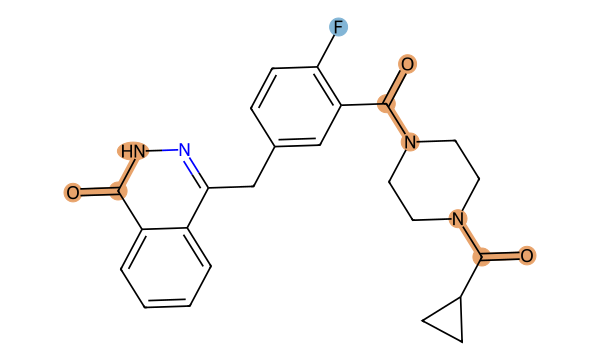
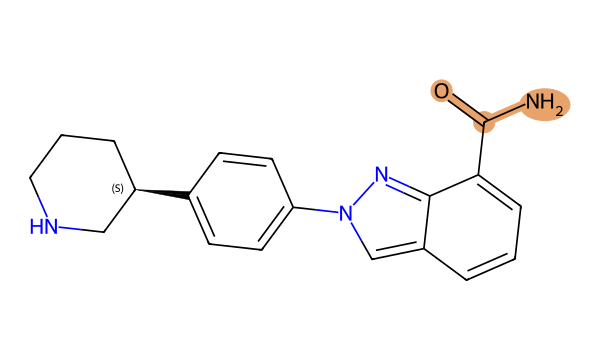
| Observation | Olaparib | Niraparib |
|---|---|---|
| C(=O)–N connections | 3 | 1 |
| Fluorine atoms | 1 | 0 |
Connect the structural observations with the fingerprint result
The selected query detects three C(=O)–N connections and one fluorine in olaparib, versus one such connection and no fluorine in niraparib. Ring connections are included. We state the query definition rather than mixing this count with an unspecified “amide count”. [Olaparib] · [Niraparib]
Fourteen shared set bits across a union of 88 give 0.159. Members of the same PARP class can show limited overlap in this representation, illustrating why target-class grouping does not establish the same molecular architecture.
No PARP trapping, cellular activity or tissue-distribution measurements enter this calculation. Those questions require separate experimental conditions and results; the fingerprint value cannot replace them.
Calculated structural similarity: 0.159 · Morgan radius 2 / 2048 bits · Tanimoto
Calculation: 14 / (54 + 48 − 14) = 14 / 88 ≈ 0.159. Set-bit counts are not counts of unique atoms or functional groups.
Query definitions and reproducibility
- C(=O)–N connections:
[#6](=[#8])[#7] - Fluorine atoms:
[F]
RDKit 2025.03.4 · Matches with identical atom sets are counted once. Colours mark atoms and bonds matching selected queries, not a proven shared scaffold or synthesis route.
- Read elemental composition from the formulas.
- Trace ring and substituent connections in each drawing.
- Compare your observations with the fingerprint score calculated under identical settings.
- Check stereochemistry and the complete InChIKey in the source records.
The score is fingerprint overlap, not a percentage of efficacy or safety. RDKit
Structure-source check: 2026-10-08 / 2026-10-08 · Editorial update and calculation check: 2026-10-16
Download source structures, queries and bit counts for this comparison (JSON)
Structure families
Key drugs · payloads
BioMoa
Editorial responsibility and corrections
Operated and edited by the independent StructureMoa project. Explanations use AI assistance; structural identity and similarity are checked against source records and calculation tests. Molecular data and clinical or regulatory evidence have separate review scopes.
- Source structures
- PubChem · CID / SMILES / InChIKey
- Calculations and automated checks
- RDKit · Morgan / SMARTS
- Disclosed specialist review
- No separate external specialist review is disclosed. Passing automated tests is not specialist review of clinical claims.
For a correction, include the page URL, molecule name or CID, the field in question and a supporting source. Corrections are checked against sources, and the affected editorial update date is changed when a correction is published. [email protected]