Structure guide · 10/7/2026
Read molecular identity before comparing structures
Use CID, SMILES and InChIKey together to distinguish records, representations and stereoisomers.
Read the two structures
Start with the ring drawings of sotorasib and adagrasib, then locate N, O, F and Cl labels. Read the formulas to compare element counts, and return to the drawings to compare where those elements connect. Composition and connectivity are separate observations.
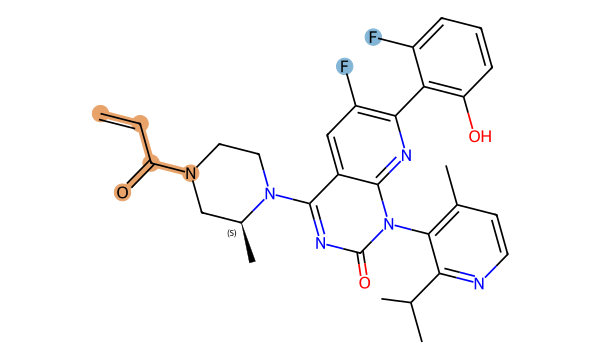
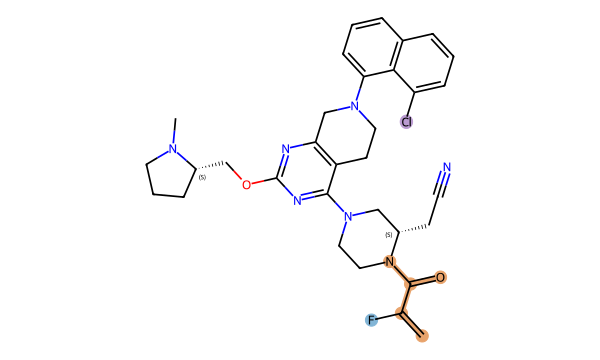
| Observation | Sotorasib | Adagrasib |
|---|---|---|
| Acrylamide connectivity | 1 | 1 |
| Fluorine atoms | 2 | 1 |
| Chlorine atoms | 0 | 1 |
Connect the structural observations with the fingerprint result
The orange C=C–C(=O)–N connectivity occurs once in each molecule. Sotorasib has two fluorine atoms attached to aromatic rings; adagrasib has one fluorine attached to the highlighted unsaturated connection and also one chlorine atom. The location and neighbouring atom environments differ, not just the element counts. [Sotorasib] · [Adagrasib]
Sotorasib has 75 set fingerprint bits and adagrasib has 83. They share 21, so the union is 75 + 83 − 21 = 137 bits. The rounded result of 21/137 is 0.153. A small common motif can coexist with limited overlap across the complete fingerprint.
The result describes radius-2 local environments in this bit representation. We have not assigned individual bits to chemical groups, so the score cannot be decomposed into a numerical contribution from fluorine or chlorine. Biological binding and efficacy require separate experimental evidence.
Calculated structural similarity: 0.153 · Morgan radius 2 / 2048 bits · Tanimoto
Calculation: 21 / (75 + 83 − 21) = 21 / 137 ≈ 0.153. Set-bit counts are not counts of unique atoms or functional groups.
Query definitions and reproducibility
- Acrylamide connectivity:
C=CC(=O)N - Fluorine atoms:
[F] - Chlorine atoms:
[Cl]
RDKit 2025.03.4 · Matches with identical atom sets are counted once. Colours mark atoms and bonds matching selected queries, not a proven shared scaffold or synthesis route.
- Read elemental composition from the formulas.
- Trace ring and substituent connections in each drawing.
- Compare your observations with the fingerprint score calculated under identical settings.
- Check stereochemistry and the complete InChIKey in the source records.
The score is fingerprint overlap, not a percentage of efficacy or safety. RDKit
Structure-source check: 2026-10-08 / 2026-10-08 · Editorial update and calculation check: 2026-10-16
Download source structures, queries and bit counts for this comparison (JSON)
A name is a starting point
A generic name, development code and brand can refer to related records rather than one identical chemical representation. Open the source record and check whether it describes the parent molecule, a salt, a mixture or a specific stereoisomer. Keep the identifier and source with the structure you actually use.
Three identifiers answer different questions
A PubChem CID locates a database record. SMILES describes atom connectivity and can include stereochemistry. InChIKey is a compact identifier derived from an InChI representation. Different SMILES strings can describe the same molecule; comparing text alone is therefore insufficient. Conversely, the same formula does not establish the same connectivity.
Worked example: sotorasib and adagrasib
Use the two drawings below. First read their individual CIDs and formulas. Then locate the rings and the atoms labelled N, O, F or Cl. Formula differences establish different composition; the drawings show how atoms are connected. Compare the full source records before interpreting any fingerprint similarity.
A repeatable reading checklist
Record the CID, source date and full InChIKey. Check salt and stereochemical representation. Compare drawings and calculate fingerprints under the same settings. Keep identity, structural similarity and biological evidence as separate conclusions. A structure-source date is not a clinical or regulatory review date.
Sources and review
Editorial update: 10/12/2026 · Structure-source check: 2026-10-08. Calculations and cited experiments are separate evidence.
Related compounds
Editorial responsibility and corrections
Operated and edited by the independent StructureMoa project. Explanations use AI assistance; structural identity and similarity are checked against source records and calculation tests. Molecular data and clinical or regulatory evidence have separate review scopes.
- Source structures
- PubChem · CID / SMILES / InChIKey
- Calculations and automated checks
- RDKit · Morgan / SMARTS
- Disclosed specialist review
- No separate external specialist review is disclosed. Passing automated tests is not specialist review of clinical claims.
For a correction, include the page URL, molecule name or CID, the field in question and a supporting source. Corrections are checked against sources, and the affected editorial update date is changed when a correction is published. [email protected]