Comparison · 10/7/2026
An ADC payload drawing is not the whole ADC
Compare MMAE and DM1 at the molecular level, then keep antibody, linker and conjugation information separate.
Read the two structures
Compare chain regions, ring regions and labelled heteroatoms in MMAE and DM1. The unit shown here is a payload molecule. A whole-ADC comparison additionally requires antibody, linker, conjugation-site and drug-to-antibody-ratio information; these drawings do not encode those components.
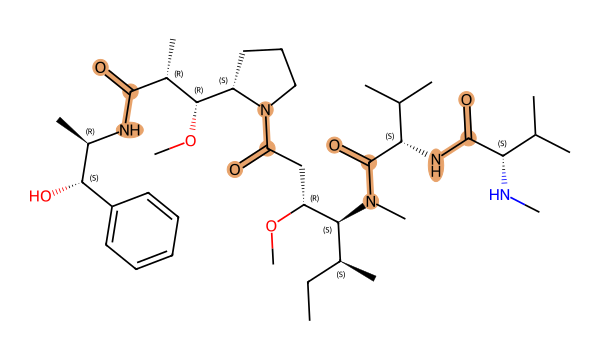
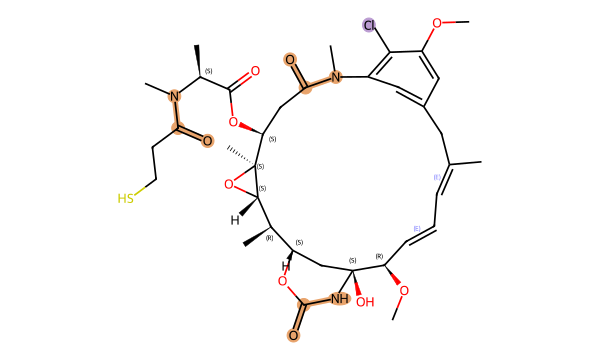
| Observation | MMAE | DM1 |
|---|---|---|
| C(=O)–N connections | 4 | 3 |
| Chlorine atoms | 0 | 1 |
Connect the structural observations with the fingerprint result
The C(=O)–N query detects four connections in MMAE and three in DM1. DM1 has one chlorine atom; MMAE has none. Selected connection counts and the full ring/chain arrangements differ between these payload molecules. [MMAE] · [DM1]
Twenty-one shared set bits across a union of 146 give 0.144. Having C(=O)–N connections in both molecules does not imply extensive overlap of complete local environments. This is why motif counts and the whole fingerprint are read together.
These are payload molecules, not complete ADCs. Antibody, linker, attachment sites and conjugation distribution are absent. Extending the comparison to products requires separate product composition and experimental evidence.
Calculated structural similarity: 0.144 · Morgan radius 2 / 2048 bits · Tanimoto
Calculation: 21 / (77 + 90 − 21) = 21 / 146 ≈ 0.144. Set-bit counts are not counts of unique atoms or functional groups.
Query definitions and reproducibility
- C(=O)–N connections:
[#6](=[#8])[#7] - Chlorine atoms:
[Cl]
RDKit 2025.03.4 · Matches with identical atom sets are counted once. Colours mark atoms and bonds matching selected queries, not a proven shared scaffold or synthesis route.
- Read elemental composition from the formulas.
- Trace ring and substituent connections in each drawing.
- Compare your observations with the fingerprint score calculated under identical settings.
- Check stereochemistry and the complete InChIKey in the source records.
The score is fingerprint overlap, not a percentage of efficacy or safety. RDKit
Structure-source check: 2026-10-08 / 2026-10-08 · Editorial update and calculation check: 2026-10-16
Download source structures, queries and bit counts for this comparison (JSON)
Choose the unit of comparison
The drawings below describe MMAE and DM1 as independently identified payload molecules. An antibody–drug conjugate adds an antibody, linker, attachment sites and a distribution of conjugated species. A payload SMILES does not encode this complete product.
Worked example: two payloads
Compare the two formulas and drawings. Identify the labelled heteroatoms and the overall ring or chain arrangement. These are payload-to-payload observations. Before comparing complete ADC products, create separate fields for antibody target, linker identity, conjugation site and drug-to-antibody ratio.
Why a single number is insufficient
Even ADCs carrying the same payload can differ in the remaining product components and experimental conditions. Payload fingerprint overlap therefore does not establish the same product exposure, safety or efficacy. A product-level claim needs product-level evidence.
Keep absent information visible
If a complete product has no appropriate single small-molecule structure representation, do not assign it the payload’s identity. Keep the payload record linked as one component. Source limitations should remain explicit rather than being filled with an unrelated molecular identifier.
Exercise · what did the MMAE–DM1 calculation compare?
Read both CIDs and formulas, then follow highlighted motifs and ring or chain connectivity. The bit counts describe these two payload inputs. Neither an antibody nor a conjugated product was encoded, so the result is not whole-ADC similarity. Overlapping motif highlights are not a percentage of molecular identity.
Use a separate worksheet for complete products
Record antibody target, linker, attachment sites, DAR and its distribution, measured analytes and sampling conditions separately. Leave unknown fields blank. Do not merge total-antibody, conjugate and free-payload concentrations. The FDA March 2024 ADC clinical pharmacology guidance is a product-level reference, not validation of this fingerprint calculation.
Distinguish the input from released chemical species
A catalog payload drawing does not represent every released or degraded species observed in cells or plasma. Identify whether the source describes free payload, linker–payload or a particular metabolite. Comparing different chemical species under one label can give a reproducible number that answers the wrong question.
Sources and review
Editorial update: 10/15/2026 · Structure-source check: 2026-10-08. Calculations and cited experiments are separate evidence.
Mechanism classes
Related compounds
Editorial responsibility and corrections
Operated and edited by the independent StructureMoa project. Explanations use AI assistance; structural identity and similarity are checked against source records and calculation tests. Molecular data and clinical or regulatory evidence have separate review scopes.
- Source structures
- PubChem · CID / SMILES / InChIKey
- Calculations and automated checks
- RDKit · Morgan / SMARTS
- Disclosed specialist review
- No separate external specialist review is disclosed. Passing automated tests is not specialist review of clinical claims.
For a correction, include the page URL, molecule name or CID, the field in question and a supporting source. Corrections are checked against sources, and the affected editorial update date is changed when a correction is published. [email protected]